Billing Schedule
Build a contract's billing phases and see every invoice it will produce.
PROGet Billing Schedule and 168 other Pro components with pro lifetime — Get Pro
- Category
- Billing
- Access
- ProPro · unlocked
- Source
- 1,749 lines · one file
- States
- 8 drawn
- Added
- 21 Oct 2026
The decision inside it
You see the invoices, not just the totals
Under the form is every bill, month by month, with any odd one explained ("Dec 2027 includes a $120.00 top-up to reach the minimum"). A gap or overlap between phases shows between them with a Fix button, and Save stays off until they line up.
When to use it
Use Billing Schedule to set up a contract's billing: phases with items, discounts and minimums, and a preview of every invoice it will produce, with gaps and overlaps between phases flagged before Save. Amounts are integer cents; the maths is exported for your server.
Installation
How you get it
Paste this into Claude Code, Cursor, Codex or any coding agent. It installs the file and uses it as it is, instead of writing a new one.
Use Liro's Billing Schedule for this.
Install it: npx shadcn@latest add @liro/billing-schedule
(the @liro registry is set up in components.json, with LIRO_KEY in .env.local)
Import it from @/components/ui/billing-schedule.
Do not rewrite or restyle it. Pass my data through its props
and keep its built-in states.
For the full brief with every prop and the mistakes assistants usually make, use Copy prompt above. Pro components install through the @liro registry with your CLI token: see the Namespaced tab.
Usage
import { BillingSchedule, type SchedulePhase, type ScheduleProduct } from "@/components/ui/billing-schedule";

const products: ScheduleProduct[] = [
  { value: "platform", label: "Platform", price: 40000 },
  { value: "seats", label: "Extra seats", price: 2000 },
];

const phases: SchedulePhase[] = [
  {
    id: "p1", start: "2027-01-01", duration: { months: 12 }, minimum: 492000,
    lines: [{ id: "l1", product: "platform", quantity: 1, price: 40000, repeat: "monthly", timing: "advance" }],
  },
];

export function ContractBilling({ save }: { save: (phases: SchedulePhase[]) => Promise<void> }) {
  return <BillingSchedule subtitle="Vertically · 2027 renewal" products={products} defaultValue={phases} onSave={save} />;
}
API reference
“Copy prompt” above puts a full brief on your clipboard, install command, dependencies, props, and the mistakes an assistant usually makes with this component.
Props
Read from the component’s own TypeScript interface when the site is built, so this table cannot drift from the file you install.
| Type | Notes | ||
|---|---|---|---|
value | SchedulePhase[] | No | Controlled phases. |
defaultValue | SchedulePhase[] | No | – |
onChange | (phases: SchedulePhase[]) => void | No | – |
products | ScheduleProduct[] | No | The catalogue offered in each item's product combobox. |
allowCustomProducts | boolean | No | Allow typing a product that is not in `products`. Default true. |
currency | string | No | ISO 4217. Default `USD`. |
locale | string | No | Default `en-US`. |
title | string | No | Default "Billing schedule". |
subtitle | React.ReactNode | No | Whose contract this is: "Vertically · 2027 renewal". |
onSave | (phases: SchedulePhase[]) => void | Promise<void> | No | May return a promise. Disabled while any blocking issue remains. |
saveLabel | string | No | Default "Save schedule". |
look | Look | No | Layered puts the total in the tray, the phases on the card and the save state in the strip. Flat is one card. |
Dependencies
npm packages
clsxframer-motionlucide-reacttailwind-mergeLiro foundations, installed alongside it
liro-themebuttoncomboboxinputsegmented-controlselectStates
All of them are drawn by the component. None is left for you to design.
- Simple yearly
- Ramp deal
- Discount
- Minimum top-up
- Gap
- Overlap
- Saving
- Saved
Accessibility
- Keyboard reachable throughout, in visual order
- Focus trapped in overlays, Escape closes them
- Focus returns to whatever opened it
- Live regions announce what changed, not that something did
- Honours prefers-reduced-motion
Responsive behavior
- Sizes to its container, not the viewport
- Usable from 320px up
- Pointer-based interaction, so trackpad and touch both work
- No hover-only affordances
More like Billing Schedule
All Billing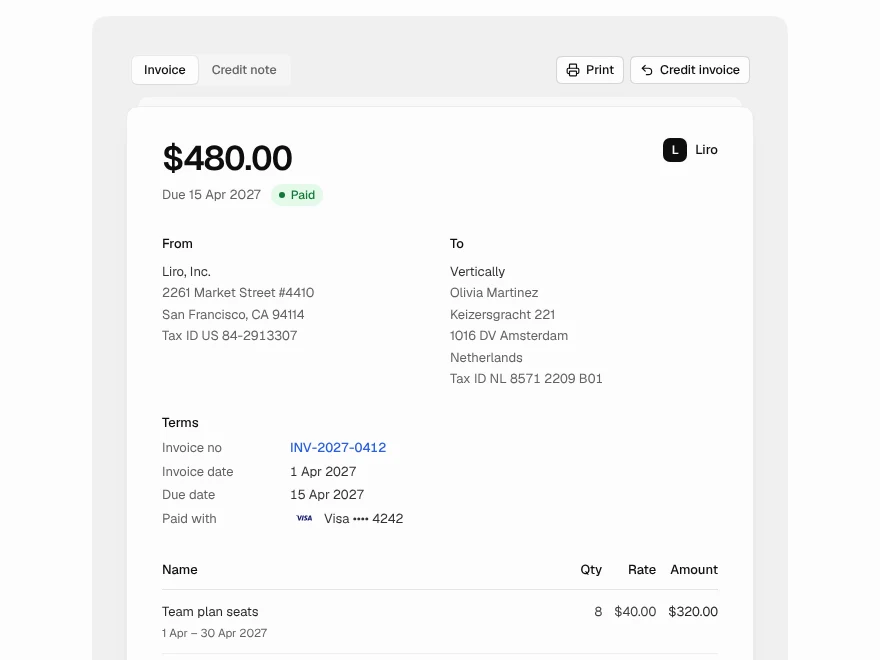 Pro
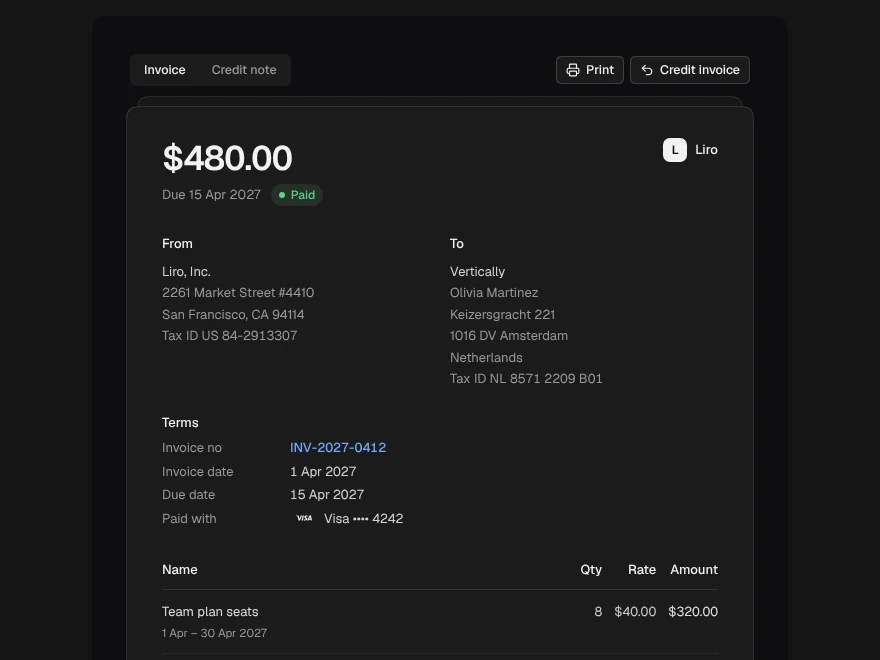
Invoice + Credit Note
Invoice with a credit note side by side.
 Pro
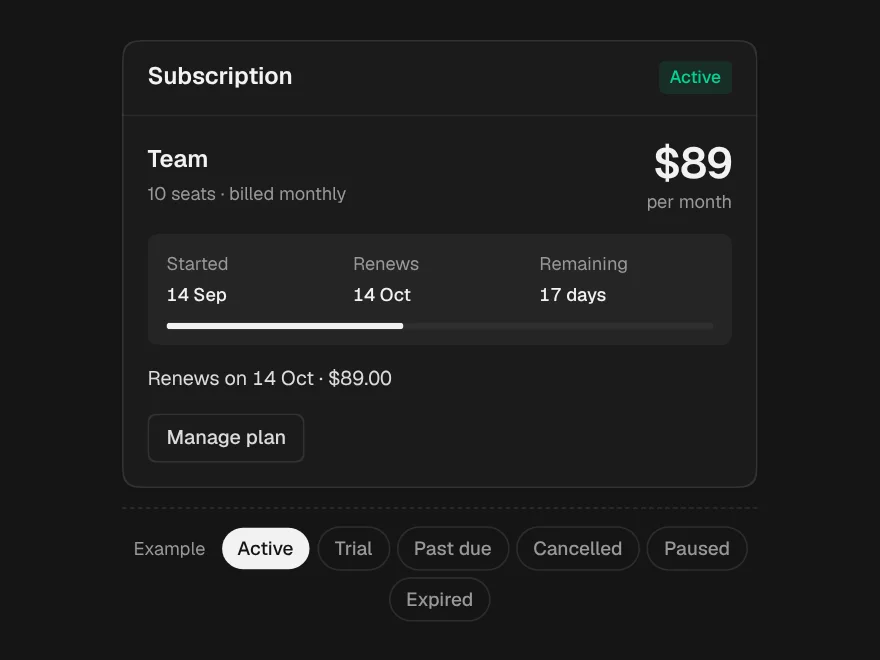
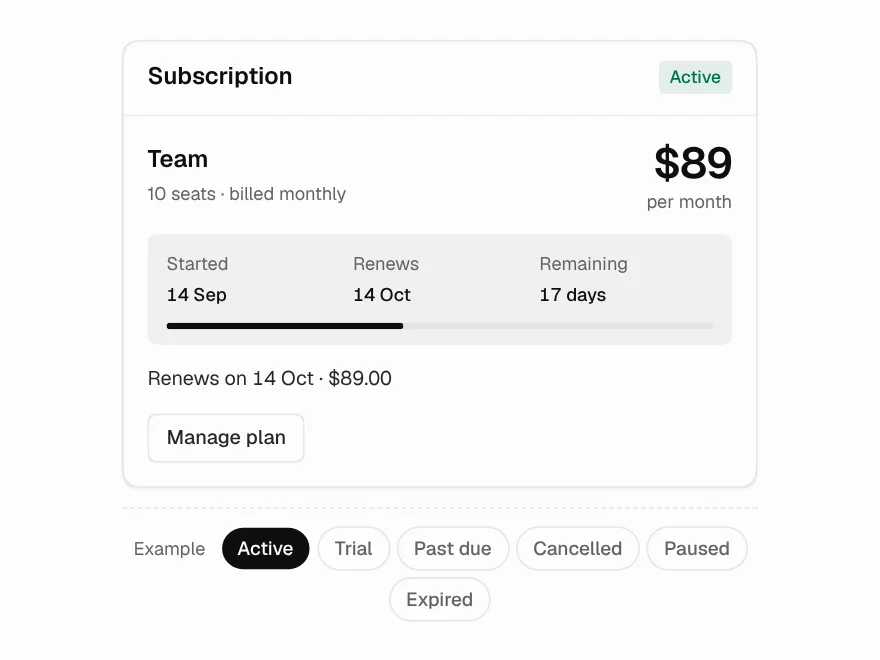
Subscription Status
Subscription status card for every plan state.
 Pro
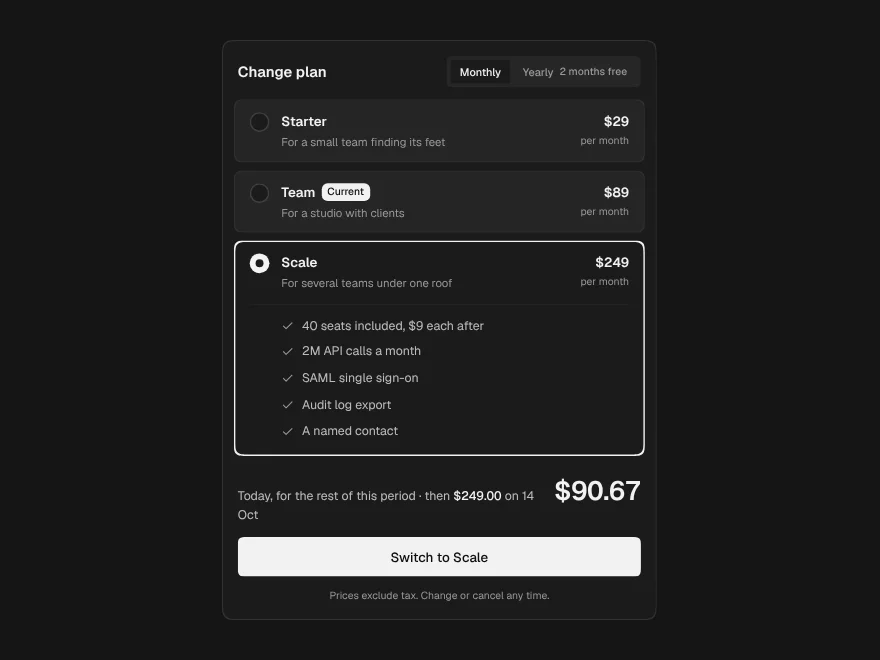
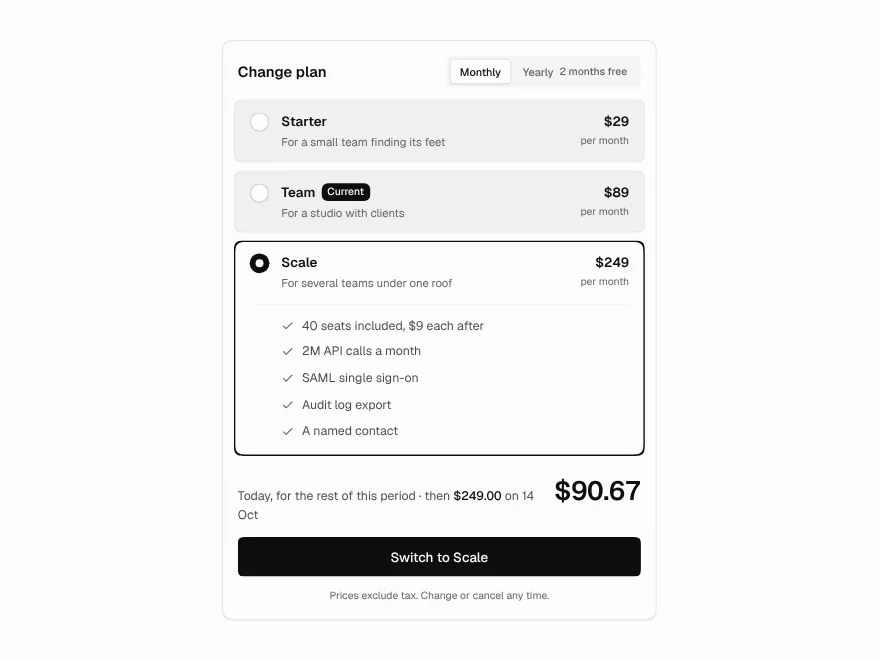
Plan Picker
Plan picker that shows the exact charge.
 Pro
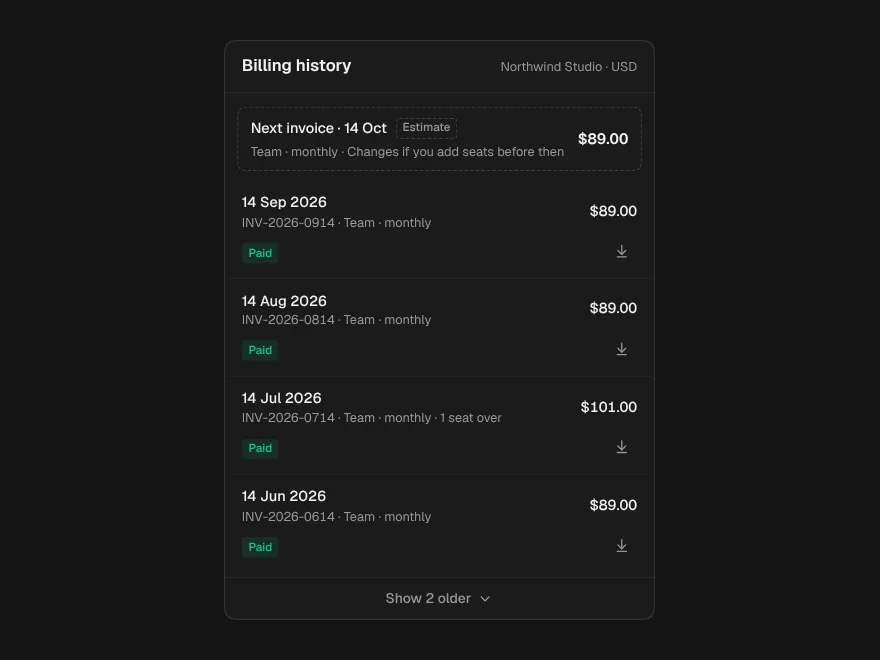
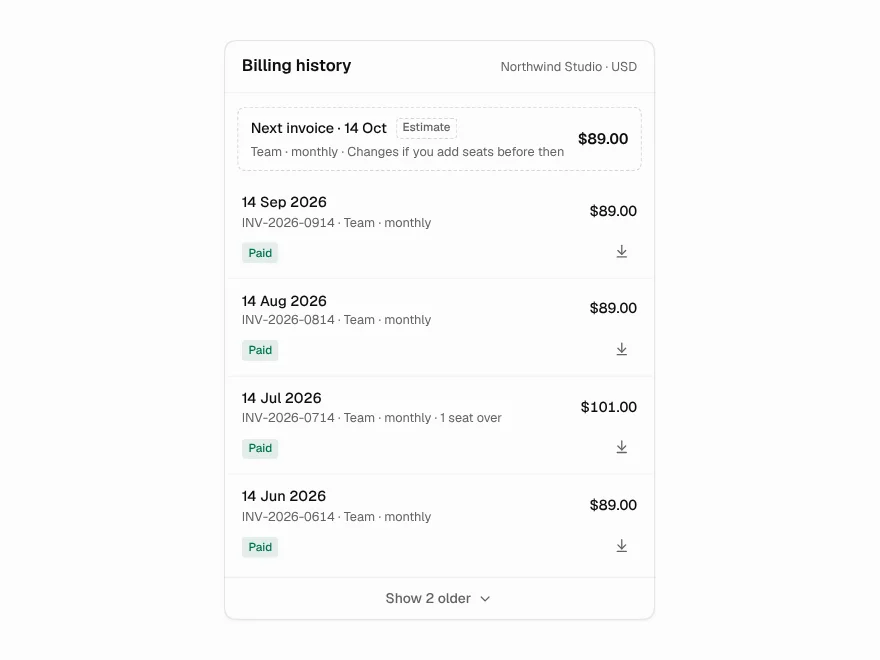
Invoice History
Invoice history with the next invoice estimate.
 Pro
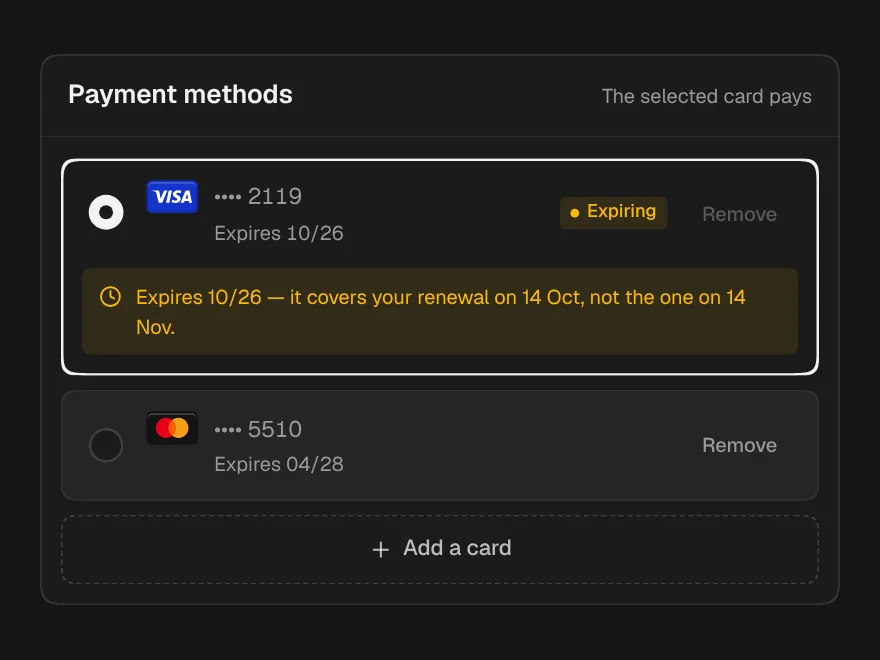
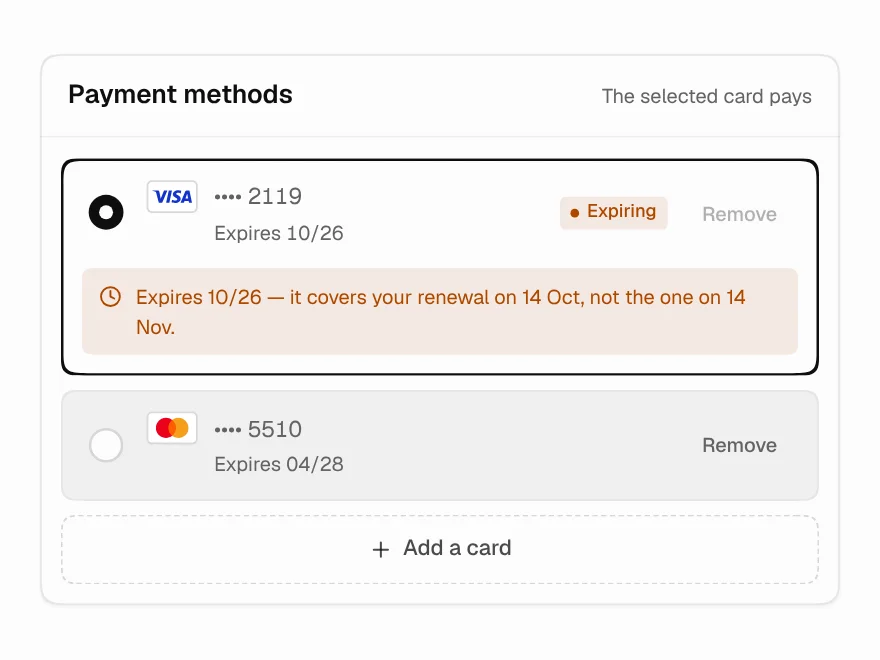
Payment Methods
Saved cards with expiry and renewal warnings.
 Pro
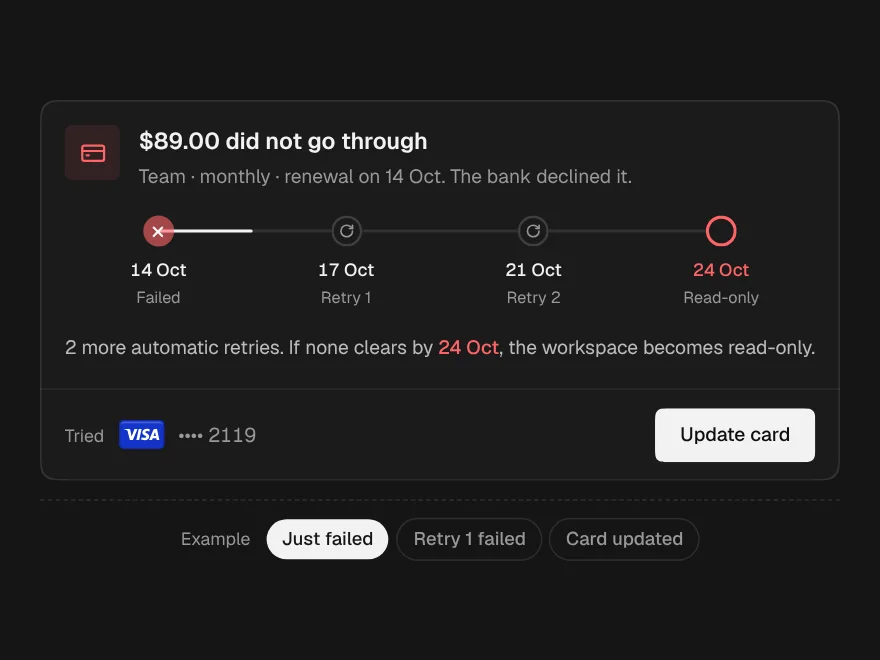
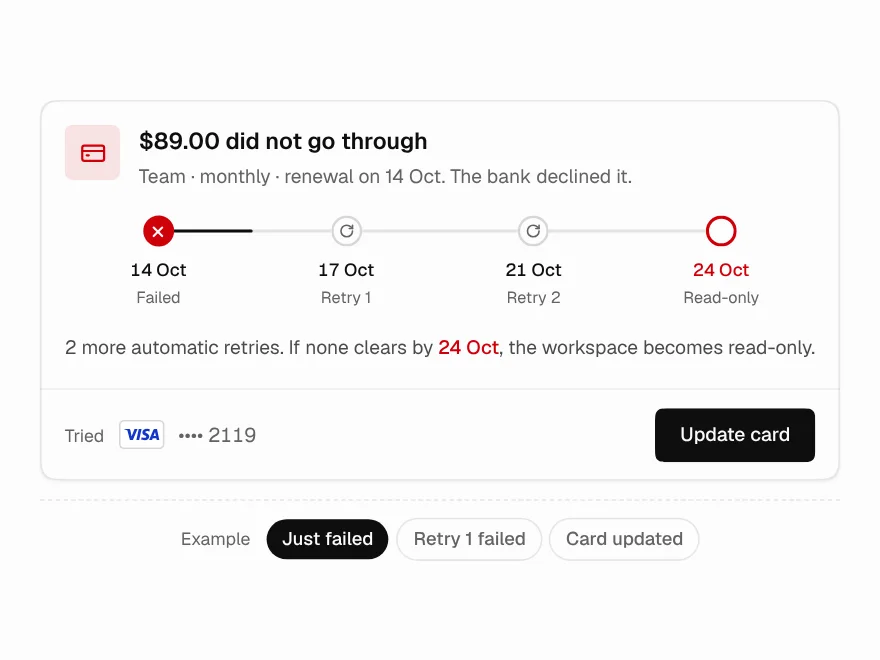
Payment Recovery
Failed payment recovery with retry timeline.